When we think about strength training, we think about movement: lifting, pushing, pulling. The bar moving, the cable shifting, resistance being overcome. But there is a type of contraction that produces no visible movement and yet contains a remarkable amount of clinical and functional information: the isometric contraction.
It is not a secondary tool or an alternative when “real training” is not possible. It is a specific method with unique properties that make it irreplaceable in certain contexts, and which clinical research has used for decades due to its reliability and reproducibility.
What it is and why it matters more than it seems
An isometric contraction occurs when a muscle generates tension without changing length, meaning no joint movement occurs. Pushing against a wall, holding a quadriceps contraction with an extended leg, or squeezing a fixed object. The muscle works intensely, but the joint does not move.
Clinically, this is crucial: the absence of joint movement means no dynamic load on potentially compromised structures. In post-operative knee patients, acute low back pain, or older adults with joint degeneration, isometrics allow safe strength assessment and training without movement-related risk.
But there is another often overlooked factor: the quality of the data it produces. Isometric tests are, alongside isokinetic testing, among the most reliable in clinical research. They are reproducible across sessions and limbs, and allow precise muscle isolation. For this reason, they have long been considered the gold standard in neuromuscular assessment. The problem is that outside the lab, measuring them properly has been expensive and difficult.
Key metrics in isometric assessment
Maximal force is not the only meaningful variable. The speed at which the neuromuscular system generates force from contraction onset is one of the most important parameters in both prevention and rehabilitation.
In fall prevention in older adults, RFD is in some studies a better predictor of risk than maximal isometric force: what determines whether someone can recover balance is not how much force they can generate in three seconds, but how much they can generate in the first 100–200 milliseconds. That is RFD, and it requires direct force-time curve measurement.
Time to peak force, mean sustained force, and repetition variability each provide different insights into neuromuscular function. Together, they form a far more informative profile than any observational functional test.
How SUIFF makes isometric assessment accessible
Until now, this level of detail required isokinetic dynamometers or force platforms—expensive, non-portable lab equipment. SUIFF changes that equation.
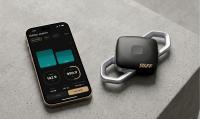
The sensor records the full force-time curve in real time during isometric contractions, capturing metrics such as peak force, mean force, time to peak and time under tension (TUT). It weighs 120 grams, connects via Bluetooth, and works with any fixed resistance point, making it suitable for clinics, gyms or home use.
Real-time visual biofeedback adds another key advantage: seeing the force curve during contraction improves the patient’s ability to consciously and effectively generate tension. This is especially valuable in early rehabilitation or in individuals with low neuromuscular awareness. It is not just measurement—it is motor relearning.
Who benefits and in what contexts
In post-operative rehabilitation, it enables early muscle activation without dynamic load. In chronic pain, it allows strength work without symptom aggravation. In athletes, it provides fatigue and load monitoring. In older adults, it offers a direct window into functional risk.
Across all contexts, SUIFF delivers the same value: turning what was once a lab-based assessment into a clinical tool with reliable data and longitudinal tracking for decision-making.
The contraction you cannot see, but that says everything
Isometric strength is invisible by nature: there is no visible movement. But the information it contains about neuromuscular function is among the richest available. With the right tools, it moves from a niche method into a central pillar of modern assessment, rehabilitation and preventive training.